
0%

Choosing the right Flake Ice Machine Malaysia isn’t just about comparing price tags and whatever capacity the brochure claims. In Malaysia, businesses deal with high humidity, warm storage areas, water quality that changes from place to place, and production schedules that don’t really slow down. A machine that runs beautifully in a cool factory might struggle right next to a busy seafood market in Johor Bahru. And yes, that difference matters.

Daniel Lim, a Malaysia-based refrigeration consultant who has worked around food processing facilities, puts it well: “The best flake ice machine isn’t the biggest one. It’s the one that matches your daily demand, your water conditions, and the service support you can actually count on.” That’s practical advice. A seafood distributor may need soft, moldable ice for fish displays, while a concrete plant might need steady output through long shifts. Those are very different jobs, so the machines should be different too.

Start with your real hourly demand—not the highest number you can imagine needing. Then look at ice thickness, drum material, compressor efficiency, drainage, and how easy it is to clean. Stainless steel can hold up better near salty coastal air. And reliable local support matters a lot, especially when production stops during a weekend delivery. Ask if replacement parts are available in Malaysia, and whether technicians really understand the machine’s refrigeration system.

Water quality deserves attention too. Hard water can leave mineral deposits on the evaporator surface. Bad drainage can mean slippery floors and sanitation headaches. These details are easy to overlook. They shouldn’t be.

A smart buying decision also weighs electrical supply, installation space, noise, and operating cost. Capacity figures may look precise, but actual output can drop in extreme heat. That’s where a lot of purchasing plans get too optimistic. Careful site assessment, checking your supplier, and realistic demand estimates—those are the safer path to choosing a dependable Flake Ice Machine Malaysia.

How to Choose a Flake Ice Machine in Malaysia?

Define Ice Demand with kg/24 h Capacity and Peak-Load Data

How to Choose a Flake Ice Machine in Malaysia?

Choosing a flake ice machine in Malaysia starts with a measurable question: how many kilograms are needed every 24 hours? A seafood stall, hotel kitchen, and concrete-cooling site will show different demand patterns. Do not size the machine from an average day alone. Record sales, delivery schedules, storage limits, and melt loss for at least seven days. Useful evidence beats guesswork.

Capacity labels such as 500 kg/24 h can mislead when operating conditions differ. In Malaysia’s hot, humid environment, water temperature, room ventilation, and condenser cleanliness can reduce real output. Ask for production data at stated ambient and water temperatures, not only a catalogue figure. Then compare that figure with your busiest three-hour period. Peak load matters.

If a fish market needs 700 kg daily but receives 450 kg before noon, a 500 kg machine may struggle. Calculate hourly production, then add practical reserve for weekends, delayed deliveries, and maintenance. A reserve of 15–25% is often sensible, but it is not universal. Your records should decide. Storage bins, drainage, electrical supply, and cleaning access also affect usable capacity. I have seen buyers focus on kilograms and overlook recovery time after harvesting ice. That estimate may still be imperfect. Recheck it after one busy month.

How to Choose a Flake Ice Machine in Malaysia?

Define ice demand with kg/24 h capacity and peak-load data.

Planning values use a 25% peak-day uplift and a further 20% operating reserve. Select a machine whose rated output meets or exceeds the recommended capacity, then validate the estimate against actual usage, storage capacity, delivery schedules, and ambient conditions in Malaysia.

Match Flake Size, Thickness, and Melt Rate to Malaysian Applications

How to Choose a Flake Ice Machine in Malaysia?

Flake size should follow the product, not the machine’s advertised capacity. FAO’s State of World Fisheries and Aquaculture 2024 reported 185 million tonnes of aquatic animal production in 2022. Seafood handling remains a major ice application. Thin flakes, often around 1.5–3 millimetres, spread quickly across fish crates. Their large contact area supports rapid surface cooling, as described in the ASHRAE Handbook—Refrigeration. However, thin ice melts faster during loading. That trade-off matters.

Choose thicker flakes for longer transport, insulated storage, or busy wet-market displays. They usually provide better durability and slower melt loss. A Malaysian Meteorological Department climate summary places many lowland areas near 26–28°C annually. Trucks and open markets can feel hotter. Small gaps in insulation then become expensive. Measure the melt. Do not rely only on laboratory ratings.

For fresh fish, use fine flakes when fast coverage is critical. For poultry, seafood distribution, or short-term storage, medium flakes may balance cooling and handling. Large flakes can suit longer holding periods, but they may leave uneven coverage. In practice, this assumption can fail. Salt content, airflow, crate depth, and product temperature change results. Test one full delivery route, including loading and unloading. Record kilograms added, product temperature, and remaining ice after four hours. Start with trials. A calculator cannot replace a tray test. Choose a machine whose adjustable thickness matches those measurements, rather than selecting capacity alone.

Check Tropical Ratings at 32–43°C Ambient and 230 V/50 Hz Supply

How to Choose a Flake Ice Machine in Malaysia?

Malaysia’s heat makes ambient rating a practical buying requirement, not a brochure detail. Check performance data at 32–43°C, especially for kitchens, seafood rooms, and outdoor service areas. A machine rated only around 25°C may produce less ice during hot afternoons. It may also run longer and consume more electricity.

Confirm the machine supports a 230 V, 50 Hz supply. Check whether the stated voltage is single-phase or three-phase. Ask for the full-load current, starting current, and recommended circuit protection. A qualified electrician should verify the site connection before installation. Small errors here can cause nuisance trips or unsafe wiring.

Look closely at ice output under tropical conditions. Do not compare daily capacity from different test temperatures. A unit producing 500 kilograms at 21°C may deliver noticeably less at 40°C. Leave clear space around the condenser. Hot, trapped air reduces cooling performance. Water quality also matters because scale can restrict flow and shorten cleaning intervals.

Measure the room first. Doorways matter. So does drainage. I have seen equipment selected correctly but installed in a cramped corner. That decision looked harmless. It was not. Ask whether the published capacity reflects clean equipment, correct water flow, and continuous operation. If the supplier cannot explain these conditions clearly, keep checking before committing.

Compare Energy Use in kWh per Ton, Water Use, and Cooling Method

How to Choose a Flake Ice Machine in Malaysia?

Compare Energy Use in kWh per Ton, Water Use, and Cooling Method

Choosing a flake ice machine in Malaysia requires three measurable comparisons: energy, water, and cooling method. Ask suppliers for kWh per ton under stated ambient conditions, not a vague “efficient” claim. Tropical heat changes performance. A machine producing one ton daily may consume more electricity when its condenser room is hot, poorly ventilated, or dusty. Practical checks show that nameplate ratings rarely reveal the whole operating story. Request test data at realistic Malaysian temperatures, then compare equal ice output and ice thickness.

Water use deserves equal attention. Measure the output. Ice production needs water, but cleaning cycles, purge water, and rejected ice increase consumption. Compare liters of incoming water per ton of usable ice. A simple meter on the feed line can expose surprisingly high losses. Filtered water may reduce scale and cleaning interruptions, though filters create replacement costs. Do not assume lower water use is always better. Insufficient purge control can leave minerals inside the system.

Cooling method matters. Air-cooled units are simpler where water is limited, but they release heat into the room. They may struggle in a crowded kitchen. Water-cooled designs can operate steadily in hot spaces, yet they consume additional water and need suitable drainage. Refrigerant choice, service access, and local technician skill also matter. Ask for maintenance intervals and measured sound levels. I would leave more space than the minimum clearance. That decision is easy to regret. No comparison is perfect. Compare operating records, not optimistic brochures, because a cheaper machine can become expensive during Malaysia’s hottest working hours.

Verify Food-Safety Design Against Codex CXC 1-1969 and HACCP

Choosing a Flake Ice Machine in Malaysia

Choosing a flake ice machine in Malaysia involves more than output, price, or footprint. Food-safety design deserves equal attention. Use Codex CXC 1-1969 as a practical reference for hygienic handling. Its principles support hazard identification, preventive controls, monitoring, and corrective action. HACCP should begin with the ice’s intended use. Will it touch seafood, drinks, or ready-to-eat food? That answer changes the required controls.

Inspect every product-contact surface. Smooth stainless steel, accessible joints, and proper drainage reduce harborage points. Avoid hidden ledges around the evaporator, chute, and storage bin. Meltwater must not flow back toward clean ice. In Malaysia’s heat and humidity, enclosed ice paths and a well-fitted lid help limit dust and accidental contact. Ask for cleaning instructions, sanitation procedures, inspection access, and maintenance records. A machine is not hygienic merely because it looks polished.

During supplier evaluation, request a hazard analysis covering water, ice, employees, condensate, and cleaning residues. Check whether water treatment is monitored and documented. Do not treat low temperature as a complete safety barrier. Keep calibration, cleaning, and corrective-action logs. They should be usable, not decorative. A checklist can still miss poor staff practices. That is worth admitting. Observe hand-contact points after installation, then review local regulatory expectations with a qualified food-safety professional. Choose equipment that supports HACCP verification every day, not only during an audit.

Evaluate Refrigerant GWP, Service Access, Warranty, and Spare Parts

Choosing a flake ice machine in Malaysia requires more than checking daily ice output. In coastal kitchens, salt air, heat, and hard water can expose weak components quickly. I have seen buyers focus on capacity, then struggle when a sensor fails during peak seafood deliveries. Evaluate the refrigerant’s global warming potential (GWP), not only its cooling performance. Lower-GWP options may support responsible operation, but confirm technician training and current Malaysian requirements before purchasing. A greener refrigerant is not useful if nobody can service it.

Service access should be practical, not just promised in a brochure. Ask whether trained technicians are available near your city, including Sabah and Sarawak when relevant. Check response times, inspection procedures, and emergency support hours. Read the warranty carefully. Does it cover the compressor, evaporator, controls, and labour? Some warranties look generous but exclude important parts. Spare parts availability also deserves attention. Request prices and estimated delivery times for pumps, sensors, bearings, valves, and control boards. I would not assume every “common” part is easy to find.

Tips: Ask for a written service plan before paying. Keep water filters and cleaning records documented. Test the machine under Malaysian room temperatures, not only showroom conditions. If the supplier avoids clear answers, pause. That hesitation may save money later. Perfect planning is impossible, but vague support is a warning.

How to Choose a Flake Ice Machine in Malaysia? - Evaluate Refrigerant GWP, Service Access, Warranty, and Spare Parts

Evaluation Dimension What to Check Practical Benchmark for Malaysia Why It Matters Suggested Evaluation
Daily Ice Requirement Rated ice production at the actual design condition, not only the maximum laboratory rating. Compare output at approximately 32–35°C ambient temperature and the intended water inlet temperature. Add a 10–20% capacity margin for peak demand. High ambient temperature and warm feed water can reduce real production compared with catalogue capacity. Essential
Refrigerant Type Refrigerant designation, safety classification, charge size, and availability of qualified service personnel. Prefer a refrigerant selected for the machine design and supported by local technicians. Confirm whether the refrigerant is permitted, available, and serviceable in Malaysia. The refrigerant affects environmental impact, safety procedures, service cost, and long-term regulatory risk. Essential
Refrigerant GWP Global Warming Potential based on the refrigerant’s stated assessment standard. For reference, R290 has a GWP of about 3.3, R134a about 1,430, and R404A about 3,922 under commonly cited AR4 values. Confirm the exact refrigerant and reference standard in the technical file. Lower-GWP refrigerants can reduce environmental impact and future phase-down exposure, but may require special flammability controls or trained technicians. High Priority
System Safety Flammability classification, refrigerant charge, electrical protection, ventilation requirements, and installation clearances. For hydrocarbon refrigerants such as R290, verify charge limits, warning labels, ventilation, component certification, and technician training before installation. Correct safety controls are necessary for legal, reliable, and safe operation. Essential
Air-Cooled or Water-Cooled Cooling method, water consumption, heat rejection, room ventilation, and utility conditions. Air-cooled units require adequate ventilation and discharge space. Water-cooled units may perform more consistently in hot rooms but use additional water and require water-quality management. Selection affects installation cost, operating cost, noise, heat load, and performance stability. High Priority
Service Access Removable panels, access to the compressor, condenser, water system, evaporator, sensors, and control board. Choose a layout that allows front or side access without dismantling adjacent equipment. Check whether filters, spray components, pumps, and sensors can be replaced quickly. Good access reduces diagnostic time, labour cost, and downtime during preventive maintenance. Essential
Maintenance Requirements Cleaning procedures for the ice-making surface, water circuit, filters, condenser, and storage area. Confirm recommended cleaning intervals, approved descaling chemicals, sanitation procedures, and whether the water system can be drained completely. Mineral scale, biofilm, and blocked airflow can reduce ice output and affect hygiene. Essential
Warranty Coverage Warranty period, covered components, labour coverage, response time, exclusions, and start date. Request the terms in writing. A practical commercial benchmark is at least 12 months for major parts, with clear exclusions for consumables, incorrect installation, water damage, and poor maintenance. A longer warranty is valuable only when parts, labour, response times, and claim procedures are clearly defined. High Priority
Local Service Response Availability of technicians in the installation region and escalation process for refrigeration or electrical faults. Ask for a written target response time, such as one business day for remote support and an agreed on-site service window for major urban areas. Ice production is often operationally critical, so downtime can exceed the cost of the repair itself. High Priority
Spare Parts Availability Availability of pumps, fan motors, sensors, solenoid valves, control boards, water filters, seals, and refrigeration components. Prefer commonly available electrical and refrigeration components. Request a spare-parts list, part numbers, prices, and estimated delivery times before purchase. Standardized parts can shorten downtime and reduce dependence on overseas shipments. Essential
Critical Spare-Parts Stock Recommended on-site stock for high-wear or failure-sensitive components. For commercial use, consider keeping water filters, inlet valves, sensors, belts where applicable, pump components, fuses, and commonly used seals on site. A small local stock can prevent extended downtime while waiting for imported parts. Recommended
Electrical Compatibility Voltage, frequency, phase, rated current, breaker size, earthing, and protection requirements. Verify compatibility with the site supply, commonly 230 V / 50 Hz single-phase or 400 V / 50 Hz three-phase systems, subject to the actual installation. Incorrect electrical specification may cause nuisance trips, motor damage, unsafe operation, or warranty disputes. Essential
Water Quality Hardness, sediment, chlorine level, filtration, drainage, and food-contact material suitability. Use the water-treatment arrangement recommended for the site. Include filtration where sediment or hardness could cause scaling, while avoiding untreated water in food-contact applications. Water quality strongly affects scale formation, cleaning frequency, component life, and ice appearance. High Priority
Hygiene and Materials Food-contact materials, cleanable surfaces, drainage, ice storage sanitation, and access for inspection. Look for corrosion-resistant materials and a design that prevents standing water. Confirm the cleaning and sanitising procedure supplied with the machine. Flake ice is commonly used with food and seafood, making sanitation and cleanability important operational requirements. Essential
Total Cost of Ownership Purchase price, electricity, water, filters, cleaning chemicals, labour, refrigerant service, and replacement parts. Compare energy and water consumption at the same ice output and operating condition. Include expected maintenance and downtime costs over at least five years. The lowest purchase price may not provide the lowest operating cost or best availability. Essential

Note: Refrigerant GWP figures are commonly cited AR4 values and may differ under other assessment standards. Warranty periods, service response times, capacity, energy use, and spare-parts availability vary by model and supplier; obtain the final specifications and written commercial terms before purchase.

Grand View Research & Fortune Business Insights Reports: GM-500KA 50-Ton/Day Flake Ice Machine

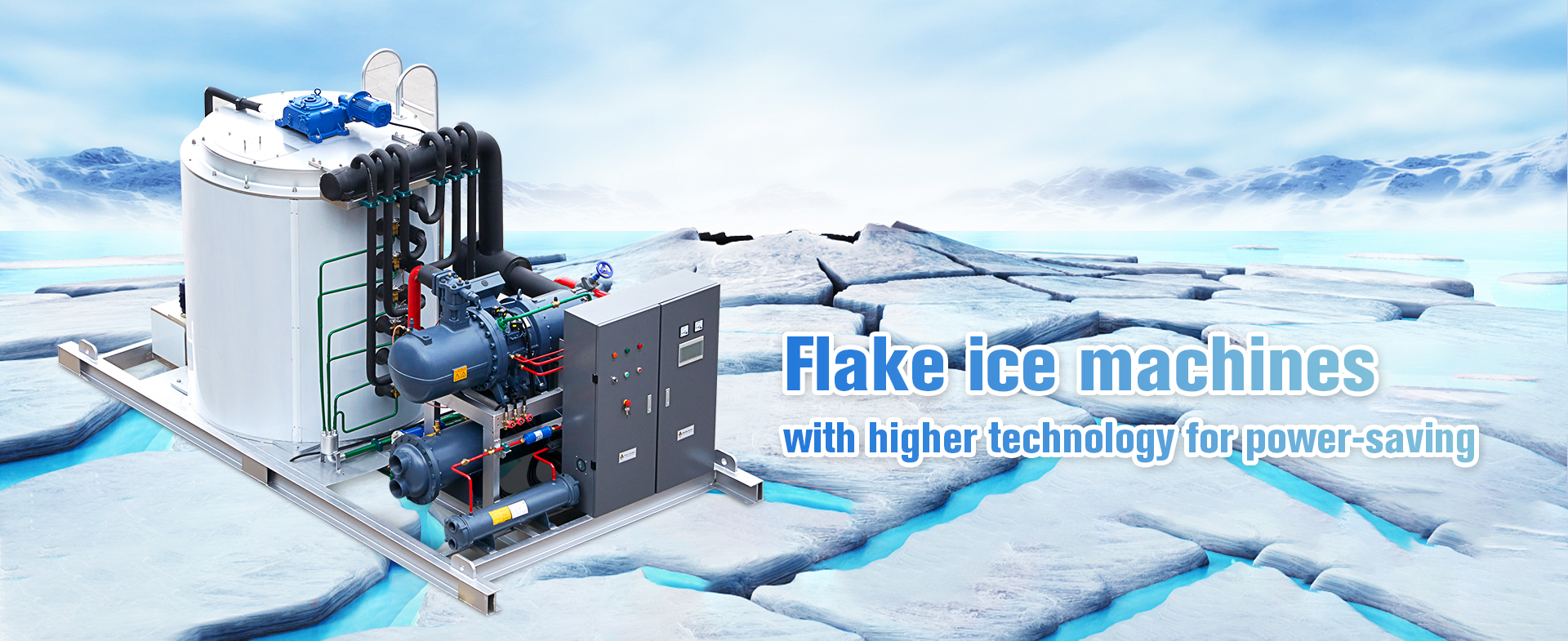
The 50-ton-per-day flake ice machine is designed for businesses that require a steady, efficient supply of ice for seafood processing, food preservation, cold-chain logistics, and other commercial applications. Its high-capacity flake ice production provides a broad cooling surface, helping products chill quickly and remain fresh during storage, handling, and transportation. The ice is clean, compact, and slow to melt, supporting dependable temperature control in demanding working environments.

An integrated PLC control system regulates the ice-making cycle with precision, making the equipment easy to operate while helping reduce unnecessary water and electricity consumption. Operators can monitor and adjust production settings through a straightforward control interface, improving convenience and consistency. The machine features a high-quality stainless-steel shell that offers strong corrosion resistance, durability, and easy cleaning. Its independent integrated structure is compact and practical, allowing efficient use of space while simplifying installation, maintenance, and daily operation.

FAQS

How should I estimate the required ice production?

Record daily ice use for at least seven days. Include sales, deliveries, storage, and melting loss. Check the busiest three-hour period, not only the daily average. Add a practical reserve of 15–25%. Your records should decide.

Is a machine rated at 500 kg/24 h always suitable?

No. The stated capacity depends on ambient temperature, water temperature, airflow, and cleanliness. A 500-kilogram rating at mild conditions may drop in tropical heat. Request performance data at 32–43°C ambient temperatures.

Why does peak load matter for seafood handling?

A market may need 700 kilograms daily but receive 450 kilograms before noon. A smaller machine may not recover quickly enough. Calculate hourly production and consider storage capacity. Recovery time matters.

Which flake thickness suits fresh fish?

Thin flakes around 1.5–3 millimetres spread quickly across fish crates. They provide broad surface contact and fast cooling. However, they melt faster during loading. Test one complete delivery route.

When are thicker flakes more useful?

Thicker flakes usually suit longer transport and insulated storage. They can reduce melt loss during busy market displays. Large flakes may cover products unevenly. Results vary with airflow, crate depth, and product temperature.

What should I measure during an ice trial?

Record the ice added, product temperature, route duration, and remaining ice. Check conditions after four hours. Include loading and unloading. A calculator cannot replace a tray test.

What tropical operating conditions should I confirm?

Ask for output at 32–43°C ambient temperature. Confirm water temperature and condenser conditions. Hot, trapped air reduces production. Leave clear space around the condenser. Clean equipment performs more reliably.

What electrical details need checking in Malaysia?

Confirm compatibility with a 230 V, 50 Hz supply. Check whether the unit is single-phase or three-phase. Ask for full-load current, starting current, and circuit protection. A qualified electrician should inspect the site.

Which installation details are easy to overlook?

Measure doorways, drainage points, cleaning access, and storage space. Provide enough ventilation around the condenser. Scale can restrict water flow. A correct machine can still fail in a cramped corner. That choice deserves another look.

Conclusion

Choosing a Flake Ice Machine Malaysia requires more than comparing purchase prices. Start by calculating daily ice demand in kg per 24 hours and identifying peak-use periods, so the machine can maintain supply during the busiest operations. Match the flake size, thickness, and melting rate to the intended application, whether for seafood display, food processing, transport, or hospitality. The selected unit should be rated for Malaysia’s tropical conditions, including ambient temperatures from 32–43°C, and be compatible with a 230 V, 50 Hz power supply.

Also compare energy consumption in kWh per ton, water usage, and the advantages of air-cooled or water-cooled systems. Food-contact surfaces should support hygienic cleaning and align with Codex CXC 1-1969 principles and HACCP-based procedures. Finally, assess refrigerant global warming potential, service accessibility, warranty coverage, and the availability of essential spare parts. A well-matched machine will provide reliable output, manageable operating costs, and safer long-term performance.

Sophie

Sophie

Sophie is a highly skilled marketing professional at Guangdong Icesnow Refrigeration Equipment Co., Ltd., an esteemed integrated manufacturer established in 2003. With an extensive background in the refrigeration industry, she possesses deep knowledge and expertise in the company's core products,......
Previous Top 10 Flake Ice Machine With Bin Types for Global Buyers